Rule Taker or Rule Maker?

August 24, 2026

AI Disruption

Most companies are using AI to get better at a game that is about to change.

That is the uncomfortable part of the AI conversation. AI disruption is often framed in terms of productivity: how AI can help employees write faster, analyze faster, code faster, and get more done. We measure productivity gains and celebrate hours saved. All of that matters. But it assumes the work itself should remain fundamentally the same. History suggests that is rarely how disruption and innovation work.

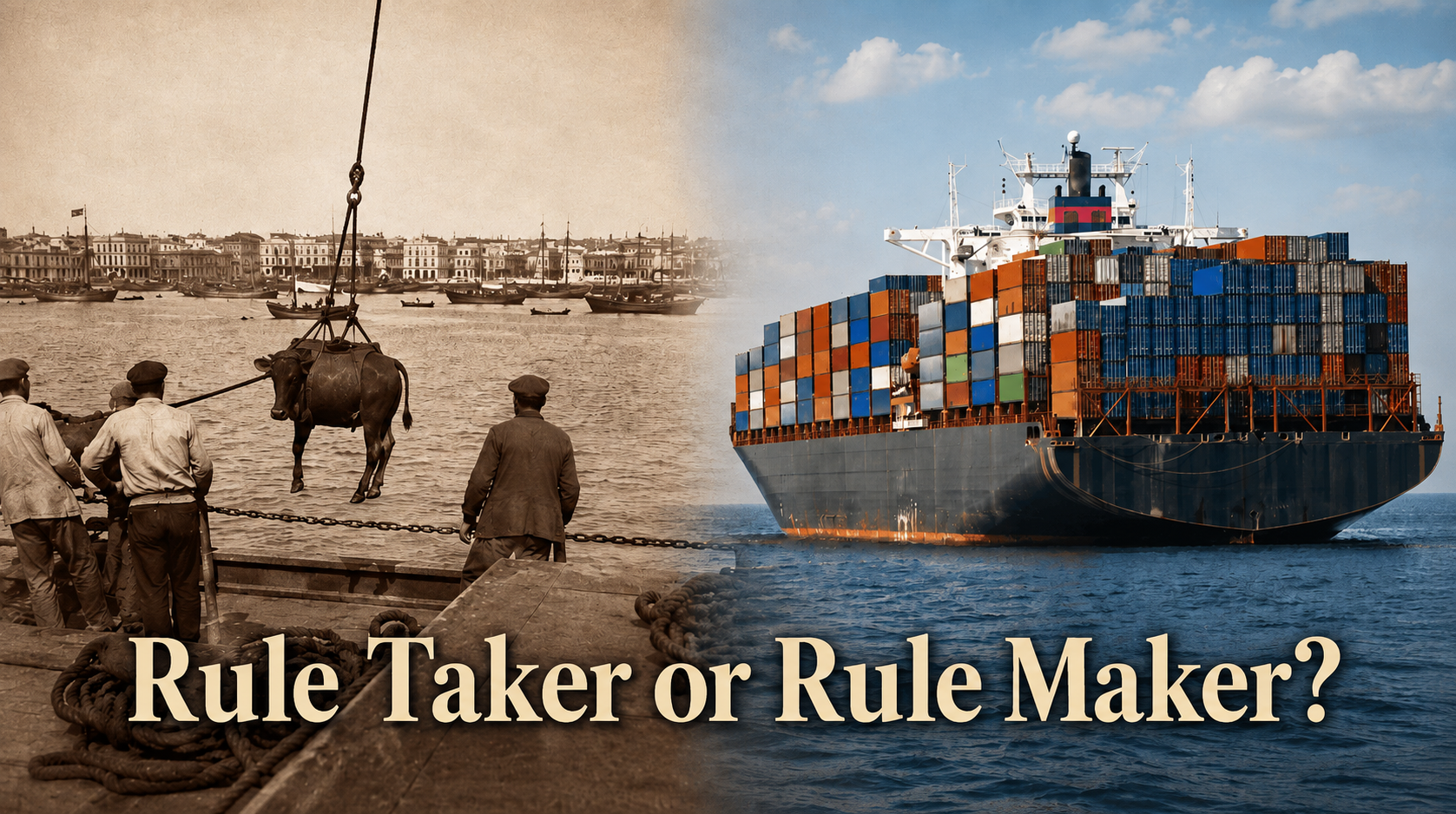
Before shipping containers, global trade was slow, expensive, and labor-intensive. Cargo arrived as barrels, bags, crates, machinery, and whatever else needed to move from one place to another. Workers loaded and unloaded it by hand, and ships could spend days sitting in port. The breakthrough was not simply putting cargo into a box. It was creating a standard box that ships, trucks, and trains could all use.

Once that happened, the system changed. Goods could move from factory to truck to train to ship without being unpacked and repacked at every stage. Ports were redesigned. Supply chains expanded, production spread, and the economics of global trade changed.

The container did not simply improve shipping. It changed the system around shipping. It changed the rules of the game. That is the kind of structural shift we need to consider when we talk about AI disruption. Through today’s lens, AI expert Sangeet Paul Choudary describes this dynamic in his book Reshuffle: when a new technology changes the underlying structure of an industry, shifting where value is created, who captures it, and how the players interact. The winners are not necessarily the companies that become better at playing the old game. They are often the ones that recognize the game itself has changed and reorganize around the new rules.

There was another side to that transformation. The new system created enormous value, but it did not distribute that value evenly. People working in the old system faced lost jobs, new skills, new equipment, and expensive transitions. The future looked better from the outside than it sometimes felt from the inside. Margaret Atwood captured that tension in The Handmaid’s Tale: “Better never means better for everyone. It always means worse, for some.”

Today AI is having the same impact, but multiplied exponentially. We tend to describe AI as automation: a machine doing something a person used to do. But a more consequential change may be coordination. AI can take raw information from many different sources, identify patterns and relationships, and turn it into a system that can continuously process information and coordinate action.

AI disruption is already reshaping industries in ways that go far beyond automating individual tasks. Reliance, India’s oil and gas giant, entered the telecom industry with Reliance Jio just as the country was moving from 3G to 4G. It invested heavily in 4G infrastructure and made voice and data almost free, quickly attracting 400 million customers.

Competitors responded with a price war, assuming Reliance was simply playing the same game. But Reliance was changing the game, using cheap data to build a massive customer base and then connecting those customers to a broader digital ecosystem of entertainment, commerce, payments and other digital services. In the years that followed, it transformed the industry, reducing it from 17 major players to just two. Jio was not just trying to win the existing game. It changed the game.

Many industries are experiencing this same dramatic shift. Translation is a simple example. Just a few years ago, translating a document was expensive and time consuming. Today, AI can translate words almost instantly and at virtually no cost. The words may be free, but the quality isn’t. Accuracy, context, tone, and cultural nuance still require human judgment. And yet, the Society of Authors found that 36% of translators had already lost work to generative AI, while 43% said AI had reduced their income. The lesson is clear: playing the same game by the same rules will steadily erode their value. To remain essential, they need to find where they can create value that AI cannot.

The same thing can happen in professions yet to be disrupted: law, accounting, medicine, consulting, marketing, architecture, software, education, and many others. AI disruption will not affect all of these professions in the same way, but the underlying question is the same: where will value move, and who will capture it?

This is where the distinction between rule takers and rule makers becomes useful. Rule takers use AI to compete within the existing model. They become faster, reduce costs, and improve margins. Those gains matter, and every organization will need to capture them.

But the biggest opportunity lies beyond efficiency. The leaders who win will recognize where value is moving and have the courage to reorganize around it. They won’t just use AI to play the existing game better. They’ll redefine the game itself.

Dr. Mark DeVolderis a Top Change Management & Transformation Expert, Award Winning Motivational Keynote Speaker Empowering Confidence through Change. He helps leaders build confidence through change, anticipate business trends, and accelerate transformations that stand the test of time. Mark has worked with industry leaders including like Qatar Petroleum, PepsiCo, Royal Bank of Canada and Pfizer, guiding teams to successfully navigate complex change initiatives.
https://markdevolder.com/keynotes/

Share This:

Book Dr. Mark DeVolder Today

Let Mark DeVolder show you how to make your next event a huge success.

Book Dr. Mark DeVolder Today

Let Mark DeVolder show you how to make your next event a huge success.

Most companies are using AI to get better at a game that is about to change.

That is the uncomfortable part of the AI conversation. AI disruption is often framed in terms of productivity: how AI can help employees write faster, analyze faster, code faster, and get more done. We measure productivity gains and celebrate hours saved. All of that matters. But it assumes the work itself should remain fundamentally the same. History suggests that is rarely how disruption and innovation work.

Before shipping containers, global trade was slow, expensive, and labor-intensive. Cargo arrived as barrels, bags, crates, machinery, and whatever else needed to move from one place to another. Workers loaded and unloaded it by hand, and ships could spend days sitting in port. The breakthrough was not simply putting cargo into a box. It was creating a standard box that ships, trucks, and trains could all use.

Once that happened, the system changed. Goods could move from factory to truck to train to ship without being unpacked and repacked at every stage. Ports were redesigned. Supply chains expanded, production spread, and the economics of global trade changed.

The container did not simply improve shipping. It changed the system around shipping. It changed the rules of the game. That is the kind of structural shift we need to consider when we talk about AI disruption. Through today’s lens, AI expert Sangeet Paul Choudary describes this dynamic in his book Reshuffle: when a new technology changes the underlying structure of an industry, shifting where value is created, who captures it, and how the players interact. The winners are not necessarily the companies that become better at playing the old game. They are often the ones that recognize the game itself has changed and reorganize around the new rules.

There was another side to that transformation. The new system created enormous value, but it did not distribute that value evenly. People working in the old system faced lost jobs, new skills, new equipment, and expensive transitions. The future looked better from the outside than it sometimes felt from the inside. Margaret Atwood captured that tension in The Handmaid’s Tale: “Better never means better for everyone. It always means worse, for some.”

Today AI is having the same impact, but multiplied exponentially. We tend to describe AI as automation: a machine doing something a person used to do. But a more consequential change may be coordination. AI can take raw information from many different sources, identify patterns and relationships, and turn it into a system that can continuously process information and coordinate action.

AI disruption is already reshaping industries in ways that go far beyond automating individual tasks. Reliance, India’s oil and gas giant, entered the telecom industry with Reliance Jio just as the country was moving from 3G to 4G. It invested heavily in 4G infrastructure and made voice and data almost free, quickly attracting 400 million customers.

Competitors responded with a price war, assuming Reliance was simply playing the same game. But Reliance was changing the game, using cheap data to build a massive customer base and then connecting those customers to a broader digital ecosystem of entertainment, commerce, payments and other digital services. In the years that followed, it transformed the industry, reducing it from 17 major players to just two. Jio was not just trying to win the existing game. It changed the game.

Many industries are experiencing this same dramatic shift. Translation is a simple example. Just a few years ago, translating a document was expensive and time consuming. Today, AI can translate words almost instantly and at virtually no cost. The words may be free, but the quality isn’t. Accuracy, context, tone, and cultural nuance still require human judgment. And yet, the Society of Authors found that 36% of translators had already lost work to generative AI, while 43% said AI had reduced their income. The lesson is clear: playing the same game by the same rules will steadily erode their value. To remain essential, they need to find where they can create value that AI cannot.

The same thing can happen in professions yet to be disrupted: law, accounting, medicine, consulting, marketing, architecture, software, education, and many others. AI disruption will not affect all of these professions in the same way, but the underlying question is the same: where will value move, and who will capture it?

This is where the distinction between rule takers and rule makers becomes useful. Rule takers use AI to compete within the existing model. They become faster, reduce costs, and improve margins. Those gains matter, and every organization will need to capture them.

But the biggest opportunity lies beyond efficiency. The leaders who win will recognize where value is moving and have the courage to reorganize around it. They won’t just use AI to play the existing game better. They’ll redefine the game itself.

Dr. Mark DeVolderis a Top Change Management & Transformation Expert, Award Winning Motivational Keynote Speaker Empowering Confidence through Change. He helps leaders build confidence through change, anticipate business trends, and accelerate transformations that stand the test of time. Mark has worked with industry leaders including like Qatar Petroleum, PepsiCo, Royal Bank of Canada and Pfizer, guiding teams to successfully navigate complex change initiatives.
https://markdevolder.com/keynotes/

Share This: