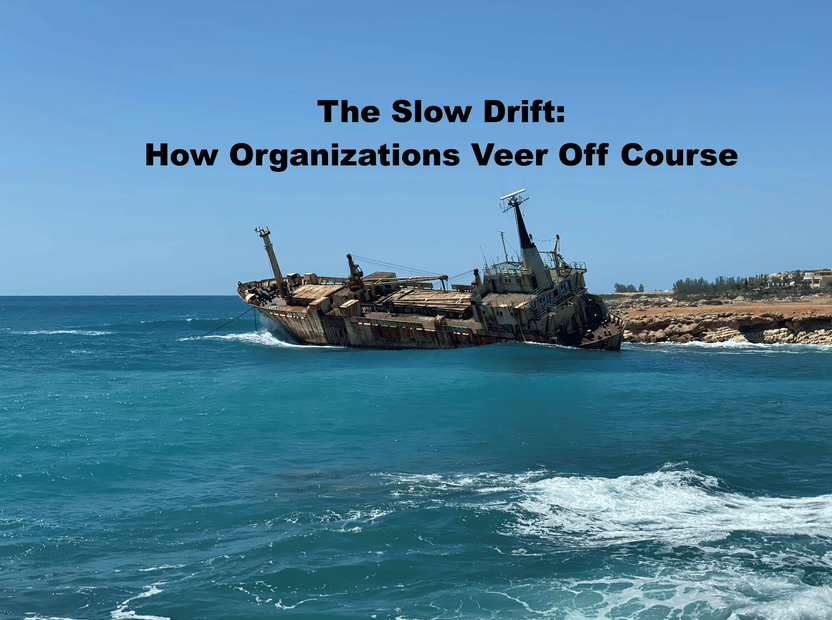
The Slow Drift: How Organizations Veer Off Course

December 11, 2025

Organizational Drift: How Organizations Veer Off Course

By now, most leaders have heard some version of the Wells Fargo fake accounts scandal. Millions of accounts were opened without customer consent, leading to billions in fines and years of reputational damage. Yet the most important lesson is not the scandal itself, it is the organizational drift that allowed it to happen. Organizational drift is quiet, subtle, and incremental, and it might be unfolding inside your organization without anyone noticing.

Drift Rarely Announces Itself

Wells Fargo did not set out to commit mass fraud. The problem began with an ordinary challenge, ambitious sales targets that created pressure. When one employee bent the rules to meet the target, nothing immediately happened. No alarms sounded, and the employee was rewarded. This small deviation quickly started to look acceptable. Over time, the shortcut spread across teams and departments, becoming normalized. Wells Fargo did not suffer a single catastrophic failure, it suffered thousands of small failures that accumulated into a systemic crisis. This is a classic example of organizational drift in action.

The Trap of “We’ve Always Done It This Way”

Organizational drift often grows quietly in routine, not in dramatic decisions. A shortcut becomes a habit, a habit becomes a norm, and a norm becomes part of the culture. By the time leadership recognizes what is happening, the system has already rewritten itself through a series of seemingly harmless compromises. Drift is the natural enemy of intentional change because it fills the space where leadership is not actively paying attention. Understanding this pattern is the first step to prevent organizational drift from taking hold.

Change Management Is About Guarding, Not Launching

Organizations love to celebrate the beginning of change with announcements, rollouts, and town halls filled with applause. But the real work happens long after the kickoff. Change does not fail loudly, it fades quietly when behaviors slip back to old patterns, when incentives reward the wrong actions, and when no one monitors how the change is playing out in daily work. Organizational drift is most dangerous during these periods of silence. Effective change management requires continuous observation, reinforcement, and adjustment. Like steering a ship, even a one-degree drift that goes unnoticed can take an organization miles off course. Leaders who proactively monitor for drift are more likely to prevent organizational drift from undermining their initiatives.

The Leadership Takeaway

Organizational drift will happen because people naturally adapt their behaviors to pressures, habits, and convenience. The question is not whether drift will occur, but whether it will move the organization toward improvement or toward risk. Leaders who understand this do more than design change, they design guardrails. They create feedback loops, monitor behavior, reward the right actions, and stay curious even when everything appears to be running smoothly. Drift thrives in silence, and leaders must learn to listen to what is not being said. Taking deliberate steps now can prevent organizational drift from growing unnoticed.

Do Not Wait for a Scandal

The Wells Fargo story is not just a banking failure, it is a human lesson for every organization. Small deviations accumulate. Culture is shaped by what leaders tolerate, not what they announce. The biggest problems often originate in small cracks that go unnoticed. If you want your organization to change with intention, you must pay close attention to the unintentional and take steps to prevent organizational drift.

If you are ready to prevent organizational drift from undermining your change efforts, start by examining where work as imagined differs from work as done. Drift grows in the gaps we assume are harmless. Shine a light on those gaps, and your organization will not only protect its change, it will accelerate it.

Dr. Mark DeVolder is a Top Change Management & Transformation Expert, Award Winning Motivational Keynote Speaker Empowering Confidence through Change. Mark can teach you how to change, anticipate business trends and accelerate future-proof transformation. He’s done it before with industry leaders like Qatar Petroleum, PepsiCo, Royal Bank of Canada and Pfizer.
https://markdevolder.com/keynotes/

Share This:

Book Dr. Mark DeVolder Today

Let Mark DeVolder show you how to make your next event a huge success.

Book Dr. Mark DeVolder Today

Let Mark DeVolder show you how to make your next event a huge success.

By now, most leaders have heard some version of the Wells Fargo fake accounts scandal. Millions of accounts were opened without customer consent, leading to billions in fines and years of reputational damage. Yet the most important lesson is not the scandal itself, it is the organizational drift that allowed it to happen. Organizational drift is quiet, subtle, and incremental, and it might be unfolding inside your organization without anyone noticing.

Drift Rarely Announces Itself

Wells Fargo did not set out to commit mass fraud. The problem began with an ordinary challenge, ambitious sales targets that created pressure. When one employee bent the rules to meet the target, nothing immediately happened. No alarms sounded, and the employee was rewarded. This small deviation quickly started to look acceptable. Over time, the shortcut spread across teams and departments, becoming normalized. Wells Fargo did not suffer a single catastrophic failure, it suffered thousands of small failures that accumulated into a systemic crisis. This is a classic example of organizational drift in action.

The Trap of “We’ve Always Done It This Way”

Organizational drift often grows quietly in routine, not in dramatic decisions. A shortcut becomes a habit, a habit becomes a norm, and a norm becomes part of the culture. By the time leadership recognizes what is happening, the system has already rewritten itself through a series of seemingly harmless compromises. Drift is the natural enemy of intentional change because it fills the space where leadership is not actively paying attention. Understanding this pattern is the first step to prevent organizational drift from taking hold.

Change Management Is About Guarding, Not Launching

Organizations love to celebrate the beginning of change with announcements, rollouts, and town halls filled with applause. But the real work happens long after the kickoff. Change does not fail loudly, it fades quietly when behaviors slip back to old patterns, when incentives reward the wrong actions, and when no one monitors how the change is playing out in daily work. Organizational drift is most dangerous during these periods of silence. Effective change management requires continuous observation, reinforcement, and adjustment. Like steering a ship, even a one-degree drift that goes unnoticed can take an organization miles off course. Leaders who proactively monitor for drift are more likely to prevent organizational drift from undermining their initiatives.

The Leadership Takeaway

Organizational drift will happen because people naturally adapt their behaviors to pressures, habits, and convenience. The question is not whether drift will occur, but whether it will move the organization toward improvement or toward risk. Leaders who understand this do more than design change, they design guardrails. They create feedback loops, monitor behavior, reward the right actions, and stay curious even when everything appears to be running smoothly. Drift thrives in silence, and leaders must learn to listen to what is not being said. Taking deliberate steps now can prevent organizational drift from growing unnoticed.

Do Not Wait for a Scandal

The Wells Fargo story is not just a banking failure, it is a human lesson for every organization. Small deviations accumulate. Culture is shaped by what leaders tolerate, not what they announce. The biggest problems often originate in small cracks that go unnoticed. If you want your organization to change with intention, you must pay close attention to the unintentional and take steps to prevent organizational drift.

If you are ready to prevent organizational drift from undermining your change efforts, start by examining where work as imagined differs from work as done. Drift grows in the gaps we assume are harmless. Shine a light on those gaps, and your organization will not only protect its change, it will accelerate it.

Dr. Mark DeVolder is a Top Change Management & Transformation Expert, Award Winning Motivational Keynote Speaker Empowering Confidence through Change. Mark can teach you how to change, anticipate business trends and accelerate future-proof transformation. He’s done it before with industry leaders like Qatar Petroleum, PepsiCo, Royal Bank of Canada and Pfizer.

https://markdevolder.com/keynotes/

Share This: